14 December, 2020 Issue
CARPET WEAVING AND ASSOCIATED DREAMSBy Syed Mustafa Ahmad
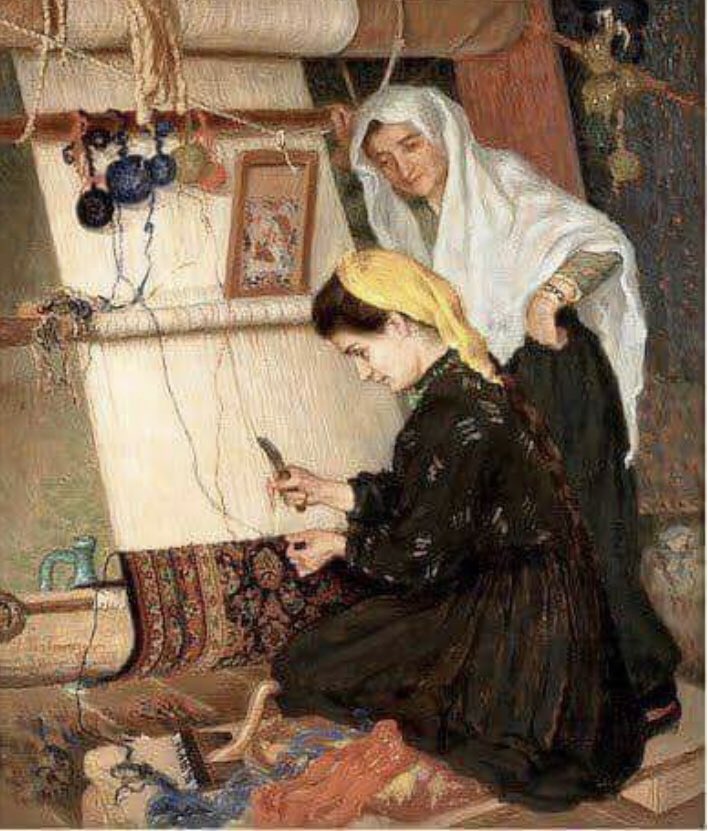
Carpet Weaving ( qaeleen kaem), from Yarqand, was a flourishing business in the past. It is said that it was the gift from those who helped to spread Islam in Kashmir. The book “ Kashmir Under the Sultans” written by Mohibbul Hassan tells that Sultan Zain-Ul-Abideen, who ruled from 1420-1470, brought different kinds of profession or occupation from the Cental Asia. Badshah( Zain-Ul-Abideen) had good contacts with outside countries like Iran, Afghanistan, Iraq, etc. Today, we often listen about the Silk Route. The modern CPEC between China and Pakistan is a small replica of that grand route. It was the route that brought Islam and handicrafts to Kashmir. This route also took Buddhism from Nepal to China. Abdul Gani Sheikh from Ladakh has written about the route in eleventh class Urdu ( JK BOSE). Zain-Ul-Abideen was influenced by the traditions of his ancestors like Sultan Shihab-Ud-Din and Sultan Sikandar. Sayyid Mir Ali Hamdani and his son Mir Muhammad Hamdani brought different professions with them in order to be self- independent. Sayyid Hamdani had written a book about the economic system in Islam that left a profound influence over people. Moreover, they were aware of the physiography and the culture of Jammu and Kashmir. In this way, it helped the native people very much. It contributed about 9,000 crore to the state exchequer. It was a remedy for unemployment. It was a perennial profession or occupation that used to provide livelihood to those who could not go to school or were forced to abandon his studies like Adil. It was a privilege for some to be engaged in this profession with the charming things like the warp and weft, knife, beating comb, shears, silk of different colors, etc. A lot of stories are associated with this business. Adil is one of them. It is full of nostalgia. Adil and his family were happy that they had a loom at their home. Adil was the third child among five. His two elder brothers were illiterate and hence labourers. Adil’s younger siblings were not highly educated. His sister was unmarried and was an Anganwadi helper. His youngest brother was working as a porter in a defense camp. Adil’s ancestors were famous for learning, particularly in Persian and Arabic. But Adil and his siblings were not so lucky in gaining any good knowledge. The heavens as well as their individual levels could not support them to achieve something concrete. Agriculture was and is the main source of income at Adil’s village. His father and his elders brothers were busy in agricultural.work while Adil took to Qaleen Kaem. When he was in the primary school, he was forced to abandon his studies. It is because in the 1980s, some so-called rich of the village brought the Carpet Weaving to the village. As told earlier it was a craze at that time to be in this occupation. They were good in one respect that it would bring monetary benefits to the village and they would not remain idle at different places like margs( Meadows), charaaes( grazing lands), Wudars( Karewas), etc. But the misery was waiting for them after a brief lull. The village, being illiterate, had some hope of literacy when in the 1980s some students like Adil began to go to the local primary school. They were happy because there was a lot of innovative things to do. Books were windows for them to look at different things and places. They felt pity over those who were busy in child labor. But they didn’t know that the misery that was more horrible than theirs, was waiting for them, with mouth wide open. Adil was forced to abandon his studies. One day, as he was coming back for lunch from the school, in the corridor of his home, his modest school uniform was put off forcefully by his father. He could not understand at that time what his father was doing to him. But one thing was crystal clear that the liberty of theirs was going to be snatched away. The local primary school contained spaces for both the school and the Qaleen Waans( Carpet Looms). He wept to his might but his father, being a hardcore person, did not feel pity over him. He was told plainly that your freedom was over. Now, you had to go to learn Kasb( Skill) so that you could live your life with ease. It was not a surprising thing for him because at that time, poverty was common. People didn’t know the value of education. They only knew that it was best to earn than to spend time and invest in educations. In history, we learn about the bonded labor. Carpet weaving too was like that. Innocent children were to sign a contract for a year or two through their parents. A small amount of money was given in advance to their parents as a goodwill gesture that you were investing in something useful. Yes, for their parents, it was an icing on the cake. They could see the face of some notes and cherish them in their hands. They could walk proudly for they had money in their dirty pockets. As the building contained both the school and the looms, there only was the shift of rooms: from classrooms to Qaleen Waans. No, it was more than that. In classrooms, there was a new world in front of the students. They learnt that my Creator, you are my hope and never leave me in want while in new rooms, there were tight strings that hurt tiny fingers. In classrooms, a teacher would give some time to rest but in the new rooms, there was a lunch break of only 25 minutes. In the classrooms, there was a hope that one day would come when we would live like birds. There would be freedom but their wings of desires were clipped before the flight. Adil, after that day’s incident, woke up next day to prepare himself for the school but to his astonishment, he was gifted with some carpet weaving tools like a knife, beating comb, shears, etc. In place of pencil, slate, and ink, he was to take iron and wooden tools with him. He was looking at them minutely but could not differentiate between the two. The former things needed freedom but no money; while the latter gave money but no freedom. Caught in this situation, Adil accepted his mother’s advice and with brimming tears, left for the same building but with a lot of differences. The rhyming sounds from the adjacent classroom would haunt him. He yearned to be among them, though they were done in number. But his heart longed to enjoy those illustrated books. Days passed and he had to bow before his fate. Carpet Weaving had come to destroy him. Years passed and it took the shape of decades. Adil made this his occupation. Working under different teachers, he, at last, installed his own loom at his home under the tutelage of the teacher from Downtown area. For Downtown area was the hub of this craft. For 15 years, Adil worked for them. He helped his family with as much as he could. Barring Fridays, he was busy on his loom through out the year. However, the long relationship came to a sudden end when he left working under the teacher. The reason was simple: no liking for quality, introduction of machines, government apathy, etc. His teacher could not keep pace with the mechanized-world. Finding himself in this situation, Adil went to the same people who had snatched his childhood from him. For two years, he happily worked but before some months, when I went to meet Adil, I didn’t find him working on loom. I couldn’t believe that Adil who was always found working on his loom, was not there. I enquired about his whereabouts. His wife told me that his health is not so good. Sitting on a loom for almost thirty years has costed him his health. He had gone to do some labor work. I began to look at the loom. It has scars. The scars given to it by nears and dears. I put my fingers into it and began to feel the spirit of Carpet Weaving. I was reminded of my childhood when my uncle used to teach me how to make carpet. Weaving a carpet needs some music. My uncle had hundreds of cassettes of different periods of both Bollywood and local types. Muhammad Raf, Kishore Kumar, Usha Khanna, Rajesh Roshan, Shailendra, Raj Kapoor, Kumar Sanu, Udit Narayan, Lata Mangeshkar, Jagjit Singh, Nida Fazili, Majrooh Sultanpuri, Nadeem-Shravan, Gulzar, Mahesh Bhatt,cetc., were and are still find there. In local sense, he has Rashid Hafiz, Gulzar Ganie, Ghulam Nabi Bhat, Abdul Majeed Ganie, Farooq Ganie, Misgar, Abdul Radhid Farash, etc. He also has some Panasonic tape recorders there to display the ingenuity of the Japanese. Today, Adil hates to work on the loom. He doesn’t expect this craft to guarantee him a good life. He has two daughters. He is living separate. He wants government to intervene. He is hopeful that if government intervenes, there are chances that it may be revived. But according to me, it is buried under the Earth. No one is interested in taking up this profession. What is the fun of being engaged in such a profession that now is a source of misery and curse! I have seen Adil fighting with his wife over this profession. Yes, his wife was right in saying that if you could not afford to meet the basic necessities of life, you would better find some alternative. I think every carpet weaver has to find an alternative. Have they? The question remains.
By: Syed Mustafa Ahmad